
People, Not Just Systems:

The Hidden Hazard in SOCI Compliance


The Human Blind Spot in Australia’s Critical Infrastructure Framework

The Security of Critical Infrastructure (SOCI) Act has reshaped the regulatory landscape, but many organisations still overlook the most human element of all: the Personnel Hazard.
 
While cyber uplift has received significant attention following the 2021–2022 amendments, the requirement to manage insider-related risks remains the least understood and least operationalised obligation under the Rules. Yet it is the one hazard type that intersects with every other hazard class: cyber, physical, operational, supply chain, and even natural hazards through human error or negligence.


Understanding the SOCI Act’s Human Dimension

Under Part 2A of the SOCI Act, every responsible entity must maintain a Critical Infrastructure Risk Management Program (CIRMP) addressing four hazard categories:
 
  1. Personnel hazards 
  2. Cyber and information security 
  3. Physical and natural hazards 
  4. Supply chain risks 
 
Most organisations gravitate to cyber controls because they are tangible and technology-driven but the Personnel Hazard is broader and more nuanced than many initially realise.
 
Personnel hazards include:
 
  • Insider misuse or unauthorised access
  • Negligence, complacency, or human error
  • Coercion, manipulation, or exploitation of staff
  • Compromised staff with divided loyalties or external pressures
 
Human behaviour can disrupt essential services as easily as a cyber-attack and in many cases, it is the root cause of one.


The Overlooked Gap: Culture and Behaviour

Many organisations assume they can meet their personnel hazard obligations through background checks or pre-employment vetting alone. However, the CIRMP Rules (LIN 23/006) require much more:
 
  • Ongoing suitability assessments for critical roles
  • Mechanisms to identify and manage behavioural risks
  • Governance and escalation pathways for insider threats
  • Documentation of responses and decision-making
  • Testing and continuous improvement
 
Pre-employment checks identify who you let in the door, they don’t tell you what happens after they’re inside.
Insider risk is dynamic. People change. Circumstances shift.
 
Financial stress, burnout, conflict, misconduct, privilege misuse or access creep all typically occur after hiring, not before.
 
This is why a CIRMP needs to integrate culture, leadership, training, reporting pathways, and behavioural monitoring, not just pre-employment checks signed off.


Integrating the CPIR with CIRMP Obligations

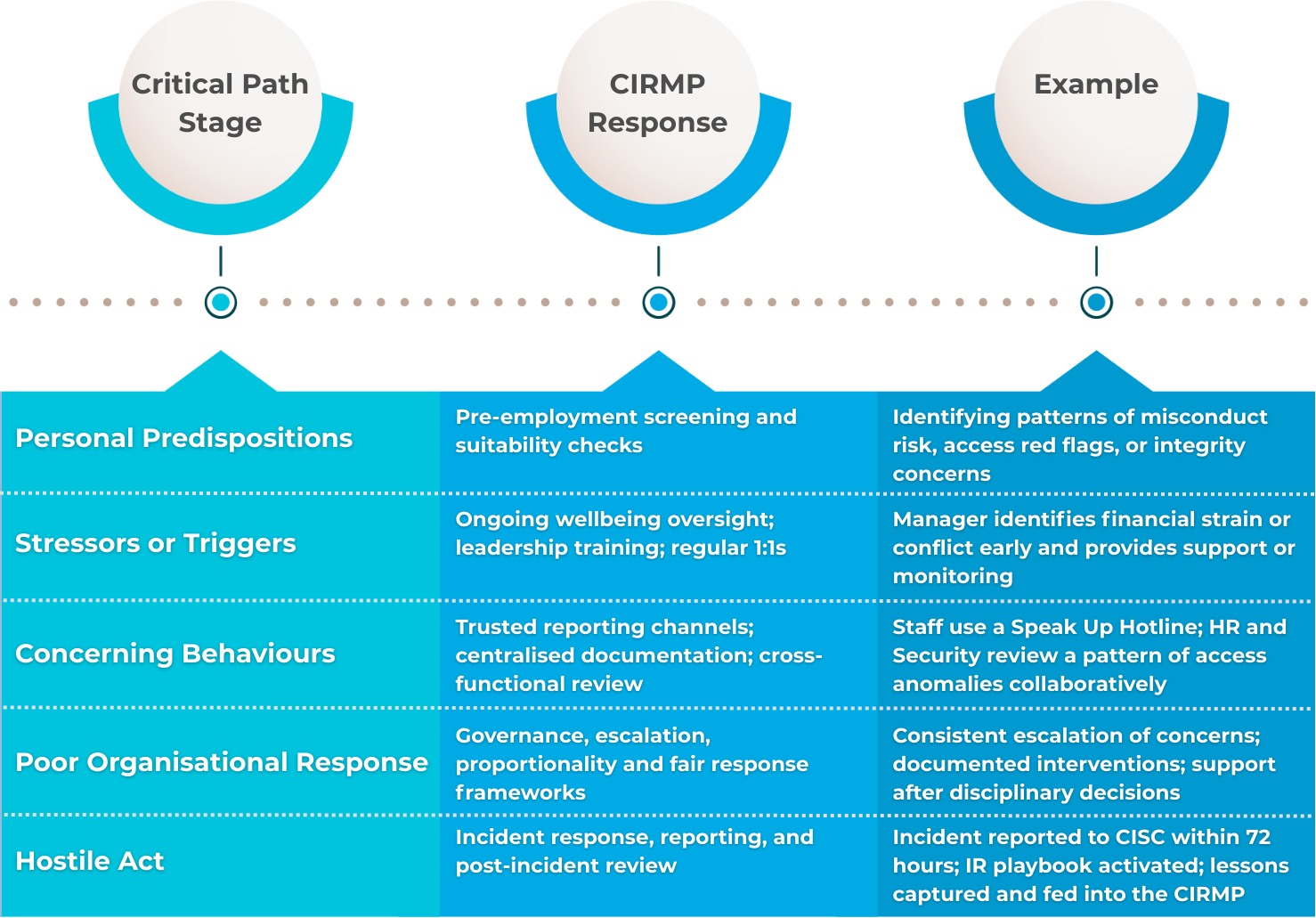
In a previous article, we explored the Critical Pathway to Insider Risk (CPIR) — a behavioural model showing how insider incidents evolve in predictable stages.
 
Aligning the CPIR with CIRMP requirements gives organisations a practical, human-centred framework to fulfil their “Personnel Hazard” obligations.
 
Below is a refined breakdown linking CPIR stages to CIRMP responses and examples.


Why This Matters: Complacency Creates Vulnerability

Critical infrastructure organisations face mounting pressure from:
 
  • Heightened geopolitical tension
  • Hybrid cyber–human threat actors
  • Employee burnout and turnover
  • Increased regulatory oversight
  • Expanding attack surfaces through technology and outsourcing
 
Despite this, personnel hazard controls remain the least mature area of most CIRMPs.
 
Common gaps include:
 
  • No central owner for insider risk
  • Siloed HR–Security–IT operations
  • No behavioural escalation framework
  • Minimal board-level visibility
  • Lack of trusted reporting channels
  • No cultural measurement or trust metrics
  • Over-reliance on technology without human context
 
This gap is exactly where threat actors operate; whether malicious insiders, manipulated staff, or accidental risk caused by vulnerable employees.


How Core Integrity Helps

Core Integrity bridges the gap between SOCI compliance and real-world behavioural risk management by helping organisations:
 
  • Embed personnel hazard controls directly into the CIRMP
  • Build cross-functional workflows between HR, Security, IT, Legal and Risk
  • Train leaders to recognise behavioural indicators early
  • Establish psychologically-safe reporting pathways
  • Implement case management and documentation frameworks aligned with CISC expectations
  • Deliver board-ready reporting on personnel hazard maturity, incidents and controls
 
We turn regulatory requirements into practical, operational, and cultural safeguards.
Find out more here: Insider Risk Services – Core Integrity


The Payoff: Moving Beyond Compliance to Culture

Organisations that treat personnel hazards as a cultural and behavioural issue not just a compliance exercise achieve:
 
  • Stronger regulatory assurance
  • Faster incident detection and more proportionate response
  • Improved cross-functional visibility
  • Greater workforce trust and safer reporting
  • Reduced likelihood of insider misuse or data loss
  • Better resilience across the entire organisation
 
When people feel supported, trusted, and accountable, insider risk decreases and organisational integrity increases.

Let's chat

Leave us a message and we will get back to you to book a meeting:


*Required fields

Are you looking to submit a report? Please click here.

Call Now Button